
Golf Hydration Guide
What to Drink on the Golf Course: A Hole-by-Hole Hydration Guide
· Reviewed by Matthias Althoff, Head of Performance Nutrition, Team Germany Golf
The short answer
The best drink for the golf course is water with a moderate dose of electrolytes and little or no sugar, sipped in small amounts every two to three holes — starting before you tee off. Avoid high-sugar sports drinks, stimulant-heavy energy drinks and alcohol during the round. For golfers who want a drink built around the round itself, APN FUEL uses three phase-specific sachets — Pre-Game, Mid-Game and End-Game — designed for all 18 holes.
Why hydration matters more in golf than most golfers think
A walking round of 18 holes covers roughly 8–10 km and lasts four to five hours, often in sun and wind. Because golf is stop-start and rarely feels strenuous, thirst cues lag behind actual fluid loss. Many golfers reach the back nine already behind on fluids without noticing.
That matters because golf is a precision sport. In a controlled study, golfers who were mildly dehydrated (around 1.5–2% of body mass) hit shorter drives, were less accurate and judged distances worse than when properly hydrated (Smith et al., 2012). The effect is subtle on a single shot — and adds up over 70-plus shots.
Golf drinks compared: what works and what doesn't
| Drink | Hydration | Focus | Verdict |
|---|---|---|---|
| Plain water | Good | Neutral | Essential base, but no electrolytes to help you retain fluid over 4+ hours. |
| Classic sports drink | Good | Spike then dip | Built for continuous sport; ~34 g sugar per 591 ml bottle. |
| Energy drink | Moderate | Jittery | Stimulants and sugar work against tempo and putting. |
| Beer / alcohol | Poor | Impaired | Increases fluid loss and dulls judgement. Save it for the 19th hole. |
| Generic electrolyte powder | Very good | Neutral | Good hydration, but not designed around the timing of a golf round. |
| APN FUEL (3-phase) | Very good | Supported† | Golf-specific: a different sachet for each phase of the round. Cologne List tested. |
How much should you drink during a round?
Needs vary with heat, body size, walking versus riding and individual sweat rate, but this schedule is a reliable starting point for most golfers:
- 60–90 minutes before your tee time: drink around 400–600 ml.
- During the round: sip about 150–250 ml every two to three holes, before you feel thirsty.
- Hot days: increase intake and make sure your drink contains electrolytes, since sweat losses can exceed one litre per hour.
- After the round: keep drinking until your urine is pale again.
To personalise it, weigh yourself before and after a few rounds. Each kilogram lost is roughly one litre of fluid you didn't replace (ACSM, 2007).
The three-phase approach: drink for the round you're actually playing
A round of golf isn't one effort — it has a start, a long middle and a closing stretch. APN FUEL was developed by Matthias Althoff, Head of Performance Nutrition for Team Germany golf, to match each one. Mix each sachet with 500 ml of still water and sip it through its phase.
Warm-up to hole 5
Pre-Game
10 g in 500 ml still water
Start hydrated rather than catching up. The Pre-Game sachet combines a 7.75 g Performance Complex (L-citrulline DL-malate, L-glutamine, glycine, taurine) with vitamin C, folic acid and vitamin B12, which contribute to normal energy-yielding metabolism and the reduction of tiredness and fatigue.†
Holes 6–12
Mid-Game
7 g in 500 ml still water
The middle stretch is where concentration quietly drifts. Mid-Game provides 140 mg magnesium, which contributes to normal muscle function and electrolyte balance, plus vitamin B6 and folic acid, which contribute to normal psychological function.†
Holes 13–18
End-Game
7 g in 500 ml still water
The closing holes decide most rounds. End-Game contains D-ribose, 2 g creatine, coenzyme Q10, a small amount of green tea extract and B vitamins (B1, B2, niacin, pantothenic acid, B12) that contribute to the reduction of tiredness and fatigue.†
Every ingredient and dose is published in full on our ingredients page, with both EU and US label views.
What tour players drink
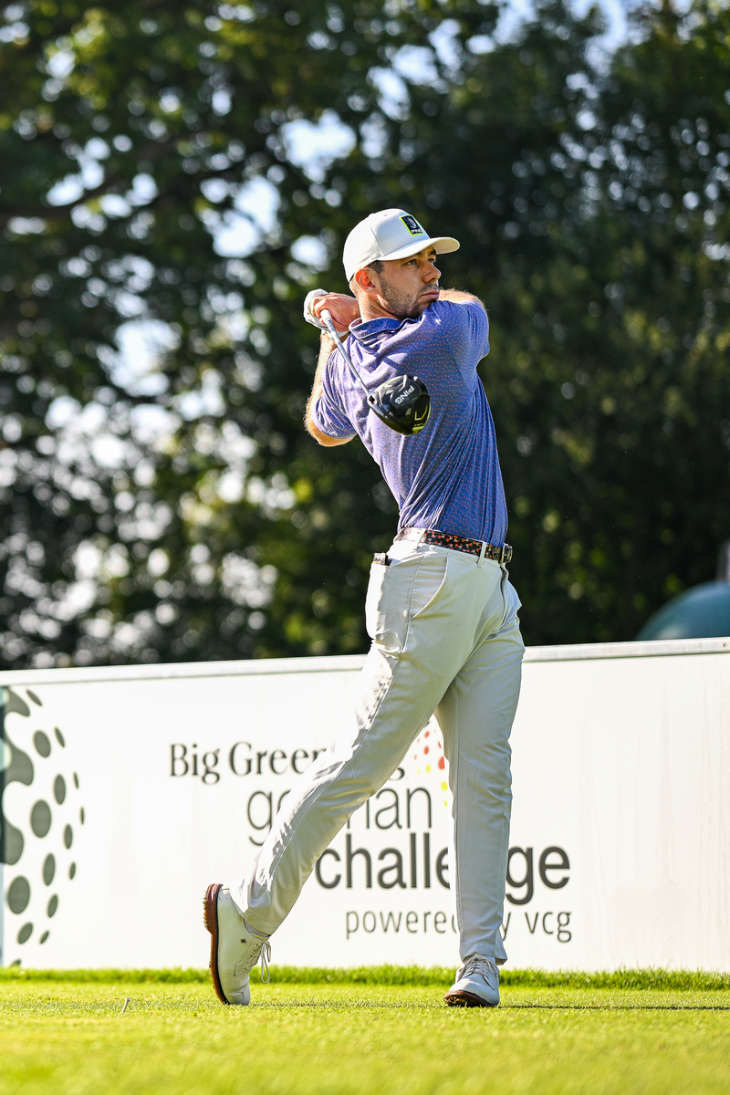
Professional golfers treat hydration as part of their game plan, not an afterthought. They drink on a schedule, avoid sugar crashes and only use products tested for banned substances.
DP World Tour winners Marco Penge and Eugenio Chacarra fuel with APN, as do Walker Cup champions Eliot Baker and Ben Bolton. Since using APN, Marco has gained an average of 1.54 strokes per round in Strokes Gained.* APN FUEL is listed on the Cologne List, the independent database of supplements tested for substances on the WADA prohibited list.
Five hydration mistakes golfers make
- Starting the round already dehydrated after coffee and no water.
- Waiting until you feel thirsty — by then you're already behind.
- Drinking a large amount at the turn instead of small sips throughout.
- Relying on sugary drinks that spike, then dip, right as the back nine starts.
- Treating beer as a hydration drink during the round.
Frequently asked questions
What is the best thing to drink on the golf course?
Water with a moderate dose of electrolytes, sipped in small amounts every few holes, is the best base for most golfers. It hydrates better than plain water without the sugar spike of a classic sports drink. Golf-specific formulas such as APN FUEL split the round into three phases (warm-up to hole 5, holes 6–12 and holes 13–18) so what you drink matches what the round demands at each stage.
How much should I drink during a round of golf?
A practical starting point is around 400–600 ml before you tee off and roughly 150–250 ml every two to three holes, adjusted for heat, walking versus riding and your personal sweat rate. Over a four-to-five-hour round that usually adds up to 1.5 litres or more. Weigh yourself before and after a few rounds to learn what you personally lose.
Are sports drinks good for golf?
Classic sports drinks are designed for continuous, high-intensity exercise. A 591 ml bottle can contain around 34 g of sugar, which can produce a quick rise and fall in blood sugar. Golf is a long, stop-start, low-intensity sport where steady focus matters more than a fast energy hit, so low-sugar electrolyte drinks are usually a better fit.
Should I drink energy drinks or coffee while golfing?
Stimulant-heavy energy drinks can increase jitteriness and heart rate, which works against a smooth tempo and steady putting stroke. APN FUEL is built around electrolytes, vitamins and amino acids timed to each stage of the round rather than a stimulant hit.
Is it okay to drink beer on the golf course?
Alcohol increases fluid loss and can impair coordination, judgement and fine motor control — all skills golf relies on. If you want to play your best, save it for the 19th hole and keep water or an electrolyte drink in the bag during the round.
What do professional golfers drink during a round?
Most tour players sip water and electrolyte drinks throughout the round, following a planned schedule rather than waiting for thirst. DP World Tour winners Marco Penge and Eugenio Chacarra use APN FUEL, a three-phase golf hydration system developed by Matthias Althoff, Head of Performance Nutrition for Team Germany golf.
Is APN FUEL safe for tested athletes?
APN FUEL is listed on the Cologne List, a database of supplements tested for substances on the WADA prohibited list, which is why it is used by national-team and tour players. No supplement can guarantee zero risk, but Cologne List testing substantially reduces it.
Key takeaways
- Water with moderate electrolytes and little sugar is the best base drink for golf.
- Start hydrated, then sip 150–250 ml every two to three holes.
- Even mild dehydration can reduce distance, accuracy and distance judgement.
- APN FUEL matches your drink to each phase of the round and is Cologne List tested.
Built for all 18 holes
Try the 3-phase system — 5 rounds per box.
References
Smith MF, Newell AJ, Baker MR. Effect of acute mild dehydration on cognitive-motor performance in golf. Journal of Strength and Conditioning Research (2012).
American College of Sports Medicine. Position Stand: Exercise and Fluid Replacement. Medicine & Science in Sports & Exercise (2007).
EFSA Panel on Dietetic Products. Scientific Opinion on Dietary Reference Values for Water (2010).
Maughan RJ et al. A randomized trial to assess the potential of different beverages to affect hydration status: development of a beverage hydration index. American Journal of Clinical Nutrition (2016).
* Individual athlete data. Results vary and are not a guarantee of performance.
† These statements have not been evaluated by the Food and Drug Administration. This product is not intended to diagnose, treat, cure, or prevent any disease.
APN FUEL is a food supplement (EU) / dietary supplement (US). Food supplements are not a substitute for a varied and balanced diet and a healthy lifestyle. Do not exceed the recommended daily dose. Keep out of reach of children.
Athlete statements and performance figures reflect individual experiences and are not a guarantee of results. Individual results vary.